The city is humid now
July in Tokyo. The air holds water. People move slowly, collars open, sleeves gone. Clothing has surrendered to the season.
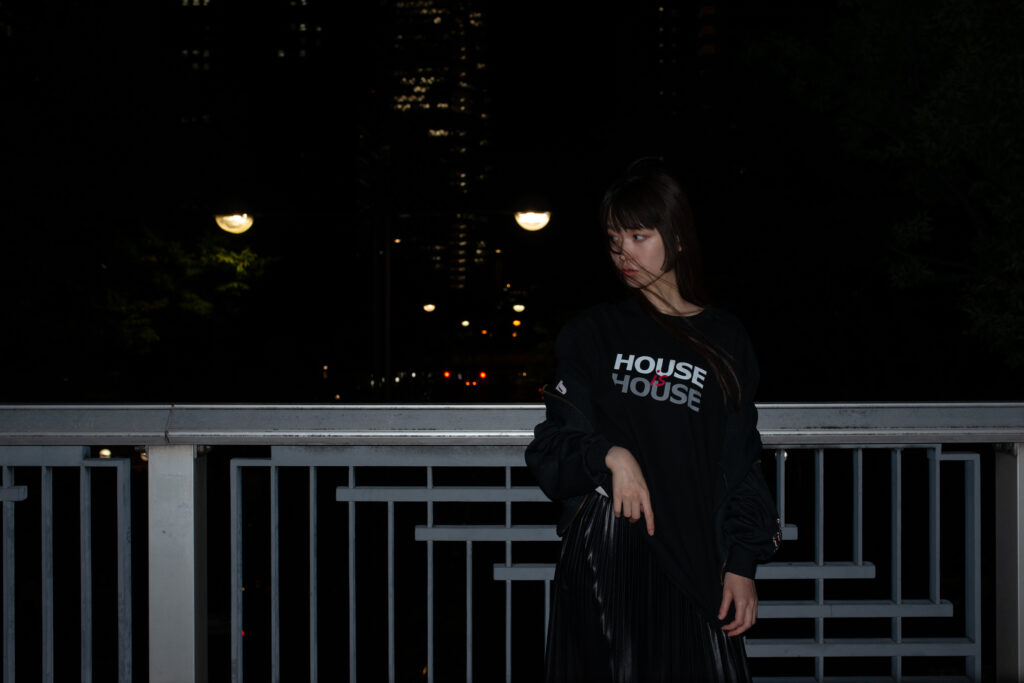
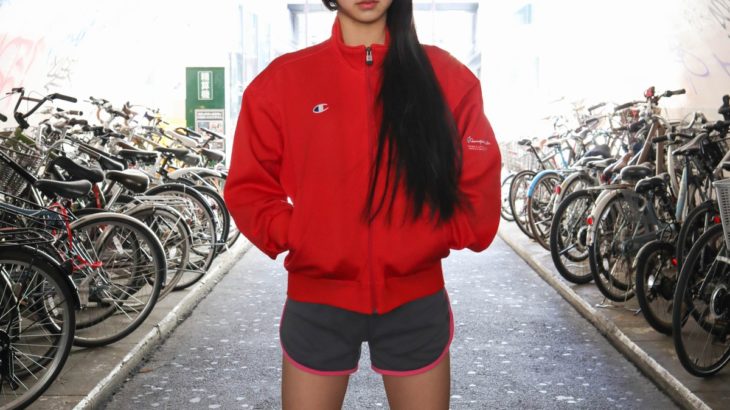
And yet — a track jacket, fully zipped, passes through the crowd. Sometimes with a mask above it. The mouth sealed twice.
If you have ever stopped at that sight — a girl in a fully zipped track jacket in midsummer, collar to the jaw, expression unreadable — this page is for you. I have been photographing exactly that, in Tokyo, for years.
Since January 10, 2018. As a project called tracktop girl. Simply, persistently documenting the presence of women with their zippers pulled up. This article is a field note from the project’s eighth summer.
What “fully zipped” actually means
A zipper is a simple mechanism, but its positions are a language.
Open: the body continuous with the world. Fabric merely draped. It is there, but no space has been created.
Halfway: a negotiation. Something offered, something withheld. The collarbone is visible — and that alone leaves a person undefended. Warmth escapes through the open chest; the gazes of others flow in to replace it. Choosing to close only halfway means carrying a small exposure all day — the quiet awareness of being not quite protected.
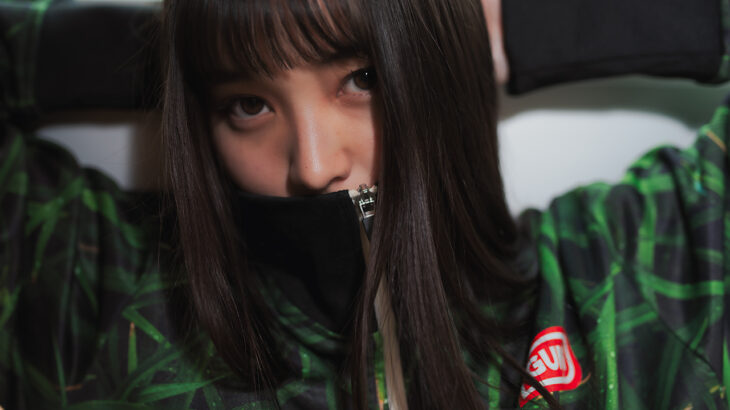
Fully zipped is different in kind, not degree. The slider reaches the point below the jaw. The high collar rises. The throat disappears. Whatever is inside — warmth, breath, the specific humidity of a body — stays inside. The jacket stops being clothing and becomes an enclosure.
I once wrote: when the zipper closes beneath the chin, the shoulder blades drop by a millimeter. Closing is what creates an interior in the first place. A place worth protecting comes into being. And only inside that enclosure can a person exhale from the very bottom of the lungs.
In winter, this reads as practicality. The gesture can hide inside utility. In July, there is no utility to hide behind. Every centimeter the slider climbs, the heat argues against it. To zip up to the chin now is a decision made against the season.
That decision is what I photograph.
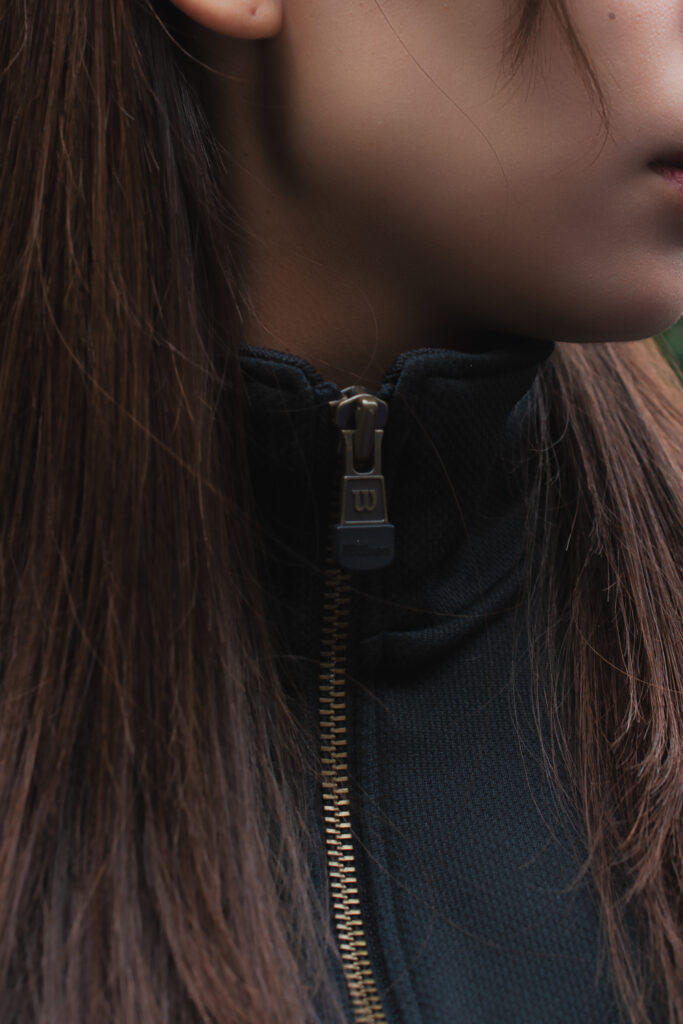
The fabric answers the day’s question
Why do jackets of the same kind feel so different in the hand?
There are days that call for the hardness of nylon. Days rescued by the weight of cotton. Nights when the smoothness of polyester is exactly right. A fabric that conforms too easily blurs your boundary. A fabric with resistance teaches you where your body ends. The resistance when you raise an arm. The sound when you roll a shoulder. The temperature against skin.
A person who has lost their outline no longer knows where they end. The jacket answers that question without a word.
And in July, polyester does different work than in winter. It holds the humidity the body releases and raises the density of the enclosure. The fabric remembers both the day’s temperature and the wearer’s. The interior of a fully zipped summer jacket becomes a private climate.
The mask above the zipper
Since the pandemic, Tokyo never fully took the masks off. Walk any street in 2026 and you will see them — in June, in July, on faces that are not sick.
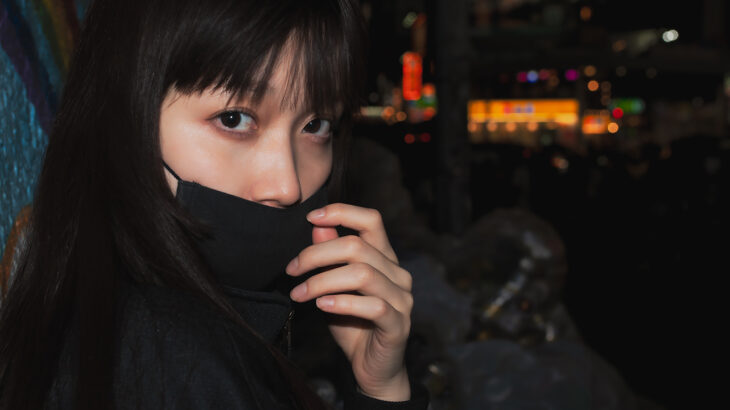
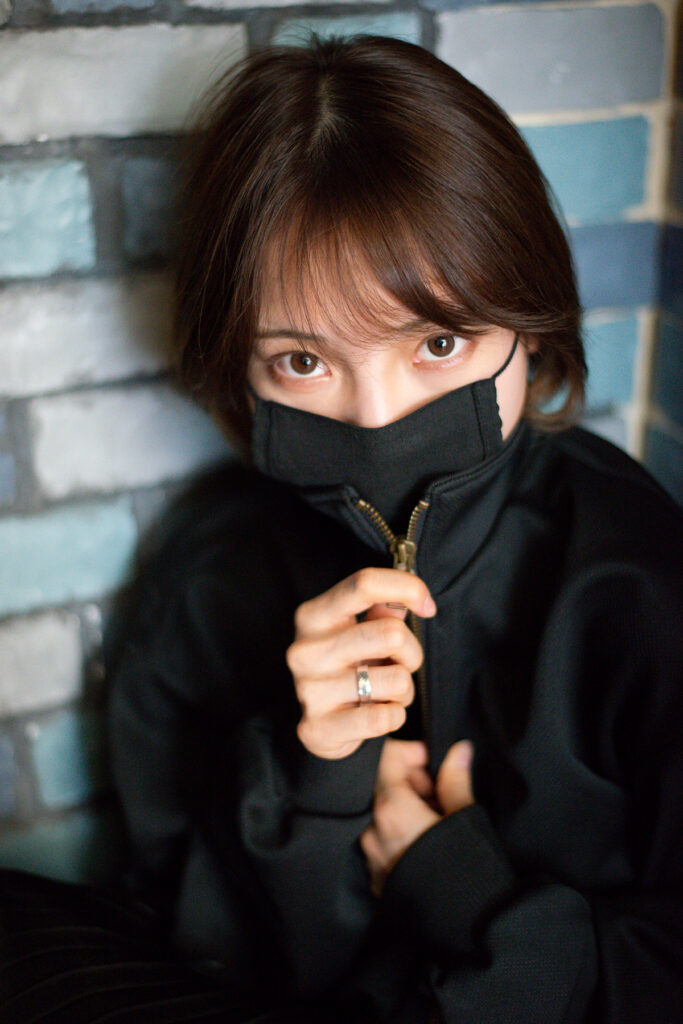
The masks in my photographs are not the pandemic’s masks. They sit low, thin, useless against anything airborne. Their function is older than hygiene: to withdraw the mouth from the city.
When a mask meets a fully zipped high collar, the seal doubles. The face reduces to a pair of eyes. Everything else — expression, mood, availability — is deliberately withheld.
The more information is blocked, the more eloquent the remaining fragment becomes. When the mouth — the part that generates words and pleasantries — disappears behind a wall of fabric, the observer’s gaze loses its destination and is forced toward the eyes. Concealing is the purest form of showing.
In English there is no single word for this. In my archive, it is simply called a specimen.
Why summer changes everything
The interior created by a fully zipped jacket in July is not the winter interior. It is warmer, closer, more humid. Polyester holds what the body releases. The enclosure becomes dense.
I will not describe the shoots in detail. I will say this: a July shoot is not a winter shoot. What we do carries real physical conditions. There are limits, and the limits are close. Everything must be prepared before the seal is made — location, light, timing. The window is short. The work is fast.
This is why these photographs cannot happen with a stranger. The person inside the enclosure has to trust the person outside it completely, and the person outside has to deserve that trust. What passes between them during those minutes is not visible in the frame.
But it is in the photograph. Somewhere. I believe that.
The history a brand carries. The narrative of merchandise from an idol group that has since disbanded. The personal bond between a model and a jacket she has worn for years. That strength of story is what transforms a web image into a work. The few sealed minutes of a summer shoot are one more form of that strength.

The reversal nobody planned
When tracktop girl began in 2018, track jackets were still sometimes dismissed as “uncool gym clothes.” There was a defiance in me then. Is there any other garment, I thought, that offers such a rich spectrum of color, form, and design to explore?
Then the reversal came — SNS, the Korean wave, the pandemic. What was once dismissed became convenient. A face half-hidden photographs well. A silhouette closed at the throat reads as style. The mask traced the same arc: what was once embarrassing became, for the young, simply useful.
Both became frictionless tools. Usable in the street, usable on the feed. Open any app and someone’s cute tracksuit photos fill the timeline.
I will be honest: there was a period when this troubled me. If the jacket belongs to everyone now, what distinguishes this project from the current it floats in?
Then something became clear. Surface-level beauty — the sign-consumption of “tracksuits are cute” — can be left to social media. It performs that role perfectly. What we present is what lies beyond it.
The answer was simple. I had been thinking about the boundary the whole time — the zipper as a line between interior and exterior, the collar as architecture, the mask as a second seal. The quiet turning point hidden in the gap of a zipper. The geometric beauty of the moment when jersey stripes overlap with the lines of the city. Not as trend coordinates. As questions. Nobody else had spent years on these questions.
The current moves on. The questions stay.
A July specimen does not cycle
The jacket cycles. The mask cycles. Trends complete themselves and dissolve.
A July specimen holds a state that existed for minutes: a sealed interior, in heat, by choice, witnessed.
In Japan there is a catchy, fast-moving phrase — “jersey-joshi,” tracksuit girls. As communication it is remarkably efficient. I have deliberately avoided it. A buzzword alone could never carry the infinite possibility of the track jacket as a canvas to the far side of the world.
That is why this project bears the name tracktop girl. A modest conviction, with no path of retreat.
That is enough reason to keep shooting through the summer.